UROVO Launches SP35 and U100 to Extend Self-Service Across the Shop Floor
New personal shopper and shelf-side solutions support a more distributed approach to self-service.
SINGAPORE, Sept. 10, 2026 /PRNewswire/ -- UROVO, a global provider of enterprise mobility and AIDC solutions, today announced the launch of its SP35 Personal Shopper and U100 Price Checker, two purpose-built retail solutions that give retailers complementary mobile and fixed touchpoints to support shoppers at different stages of the in-store journey.
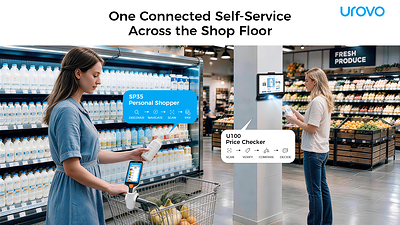
As retailers balance rising expectations for convenient in-store experiences with pressure on store teams, they need to make shopping tasks easier to complete without staff assistance. The SP35 extends mobile self-service to the shop floor, while the U100 provides a dedicated shelf-side point for product information and retail services.
"Self-service is moving beyond fixed destinations and becoming part of the broader shopping journey," said Zhang Bo, CTO of UROVO. "Retailers need technology that can meet shoppers where they need information, assistance and transaction capabilities—not simply where a kiosk is installed. SP35 and U100 give retailers a practical way to extend digital capability to more moments in the store, without adding complexity for shoppers or store teams."
SP35 Personal Shopper: Enable More Independent Shopping
- Item Location — Optional UWB-powered positioning helps shoppers locate and navigate to products.
- Scan-as-You-Shop — Barcode scanning and auto-scan mode support item capture with fewer manual steps.
- Mobile Payment — NFC and SoftPOS support contactless payments.
U100 Price Checker: Bring Product Information to the Shelf
- Pricing Display — A compact, tablet-like design features a 10.1-inch HD touchscreen for displaying regular, promotional and member pricing.
- Product Identification — Optional UHF RFID supports multi-item reads for product lookup and comparison.
- Shopper Interaction — Presence sensing wakes the display as shoppers approach; idle screen supports promotional and informational content.
Together, SP35 and U100 extend self-service across the shopping journey, helping retailers handle routine product, pricing and payment interactions with less staff intervention while allowing store teams to focus on higher-value shopper service.
Meet UROVO at NRF 2026: Retail's Big Show Europe
UROVO will showcase SP35, U100 and its connected retail portfolio at NRF 2026: Retail's Big Show Europe, Sept. 15–17, at Paris Expo Porte de Versailles, Hall 6, Booth B-020.
About UROVO
Founded in 2002, UROVO is a global provider of enterprise mobility and digital business solutions, specialising in barcode, RFID, mobile computing, printing and payment technologies. Visit: UROVO.
Media Contact
claire.bell@urovo.com
 View original content to download multimedia:https://www.prnewswire.co.uk/news-releases/urovo-launches-sp35-and-u100-to-extend-self-service-across-the-shop-floor-302871163.html