IBM and the USTA Introduce New AI-Powered Fan Experiences for 2026 US Open
NEW YORK, Aug. 24, 2026 /PRNewswire/ -- IBM (NYSE: IBM) and the United States Tennis Association (USTA) today announced new and enhanced AI-powered fan features coming to USOpen.org and the US Open app for this year's tournament. Three new, enhanced AI-powered innovations are designed to help fans cut through the noise, stay closer to the action and experience the US Open in a more personalized way than ever. Since 1992, IBM and the USTA have brought some of the most advanced digital experiences in sports to more than 14 million global tennis fans annually.
This year's tournament comes at a time when audience demand for AI-powered features is gaining momentum, as accuracy, not speed, shapes the digital sports experience. According to a new global survey also out today from Morning Consult and commissioned by IBM, 91% of global tennis fans surveyed use sports apps during events, with high trust (64%) in AI-powered sports content.
At the heart of this year's experience is the all-new Live Updates homepage — a smarter, more personalized way for fans to follow the action that matters most to them. Fans can prioritize their favorite players and quickly zero in on the matches, insights and stories they care about most.
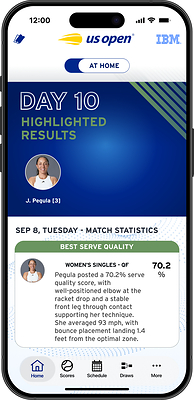
A new Serve Quality metric puts a whole new spin on how fans watch serves. Available across all 254 singles matches, the AI-powered tool uses advanced limb-tracking technology developed with IBM Bob to help analyze the precise mechanics of every serve – with 21 data points across the body and racquet, tracked 50 times per second. That means everything from wrist flex to the transfer of energy from a player's legs through their torso is captured, generating roughly 1.2 billion data points over the course of the tournament. The continuous stream of live data — including efficiency, accuracy, consistency and ball toss — is managed by IBM Confluent. The result: a Serve Quality score generated in near real-time, giving fans a new way to understand what makes a great serve great.
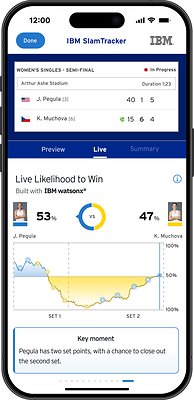
Also new this year, Key Moments takes the popular live Likelihood to Win feature a step further, helping fans understand not just who's winning – but why. Available for all singles matches, Likelihood to Win calculates each player's probability of victory using an AI-powered analysis of current and historical statistics, expert opinion and match momentum. Key Moments provides additional, richer information, to summarize the swings, turning points and momentum shifts that change each match in an instant.
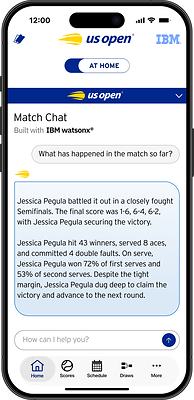
The enhanced Match Chat acts as an interactive companion throughout each match, letting fans ask questions in their own words to get instant, conversational answers. Some responses now go beyond text, bringing in relevant photos and video to add even more context. Match Chat, powered by watsonx Orchestrate, draws on an expanded mix of live match data, analysis and historical information. A collection of AI agents and fit-for-purpose models trained in the USTA's editorial style and the language of tennis make responses feel right at home on the court.
"Our work with IBM this year has been game-changing, pushing the boundaries of what's possible in digital fan engagement," said Brian Ryerson, Senior Director, Digital Strategy, USTA. "By leveraging their AI capabilities, we're delivering new, innovative, and highly personalized content and insights to our millions of fans worldwide, while significantly enhancing our ability to tell compelling stories throughout every match of the US Open."
"Our partnership with the USTA continues to redefine digital sports experiences," said Jonathan Adashek, Senior Vice President, Chief Global Affairs Officer at IBM. "We can take millions of live data points streaming from the court and automatically route them into workflows that deliver usable insights in minutes and hours. These capabilities of Confluent, Bob and other IBM technologies help deliver a more intelligent experience, drawing greater value from data and changing the game for the US Open."
The 2026 US Open runs from August 23 – September 13. Explore these IBM technologies and more by visiting USOpen.org and/or the US Open app available in the Apple and Android app stores on all mobile devices.
About IBM
IBM is a leading provider of global hybrid cloud and AI, and consulting expertise. We help clients in more than 175 countries capitalize on insights from their data, streamline business processes, reduce costs and gain the competitive edge in their industries. Thousands of governments and corporate entities in critical infrastructure areas such as financial services, telecommunications and healthcare rely on IBM's hybrid cloud platform and Red Hat OpenShift to affect their digital transformations quickly, efficiently and securely. IBM's breakthrough innovations in AI, quantum computing, industry-specific cloud solutions and consulting deliver open and flexible options to our clients. All of this is backed by IBM's long-standing commitment to trust, transparency, responsibility, inclusivity and service. Visit www.ibm.com for more information.
Media contact:
Paul Pettas
IBM
paulpettas@ibm.com
 View original content to download multimedia:https://www.prnewswire.co.uk/news-releases/ibm-and-the-usta-introduce-new-ai-powered-fan-experiences-for-2026-us-open-302857821.html